


Bird Sightings
27th October to 3rd November 2023
Fairly windy and a lot of rainfall throughout this period with very few birds around or moving on some days. A bit of respite on 30th saw a little more passage before a series of storms blew in from the Atlantic, with Storm Ciarán arriving in the evening of 1st November.
After one previous record on 16th November 1956, only the second Lundy record of Surf Scoter was found off the east coast on 27th. The female-type bird was initially picked up beyond Rat Island but obligingly moved closer into the Landing Bay, allowing better observation and confirmation of its ID. Unfortunately, a Great Northern Diver resurfaced beside the scoter and spooked it, causing it to fly back out to sea. Unfortunately, it was not seen again. An adult female Shelduck was present on the flooded ground beside the water tanks during the daily census on 3rd November. Three Teal were seen over the sea from the east coast on 1st, later seen sitting in the calm waters of the Landing Bay. The following day they had joined our single bird on Pondsbury, and on 3rd another two birds had joined the flock, making a total of six.
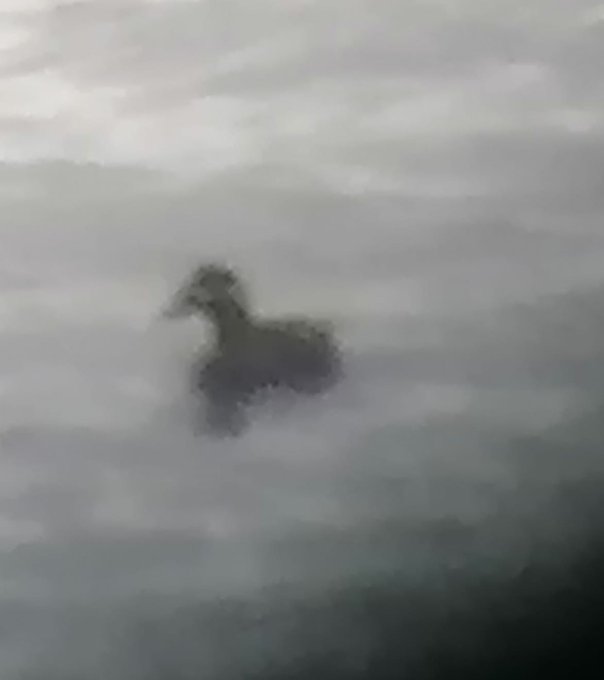 Record shot of the female-type Surf Scoter in the Landing Bay © Andy Jayne
 Adult female Shelduck near the Water Tanks © Angus Croudace
A check of Brazen Ward on 28th October found a flock of 32 Oystercatcher, the highest count since spring. A single Golden Plover overflew the Airfield on 30th and was calling high over Millcombe on 31st, and heard again over the water tanks on 3rd.
Nocturnal survey efforts continue, made somewhat easier by the changing clocks. Another three Woodcock were ringed on 30th with two other birds seen and another single flushed in daylight on the Lower East Side Path. Unfortunately one carcass was found in SW Field on 3rd; likely a Peregrine Falcon kill. Three Jack Snipe were found on 30th, with one ringed, and another was found near Quarter Wall in daylight hours on 31st. The island is holding a large amount of surface water at the moment with plenty of excellent areas for Snipe to roost or feed, so they're turning up all over the place, not just in a few key areas that were typically frequented earlier in the autumn. Barton Field has contained a Jack Snipe on every survey since mid-October, but now we're encountering them in places such as the Airfield too. High counts of six Snipe were recorded on 30th and 2nd, with two separate observations of a bird being pursued by a Peregrine on 29th and 30th.
The storms saw seabirds gathering to feed in weather windows in the lee of the island towards the end of this period, with 500 Kittiwake on 31st and over 1500 on 1st November. Over 100 Gannet and 80 auks amongst them. Our long-staying winter plumage Great Northern Diver was joined by another, complete with much of its glorious summer plumage, on 28th. A third bird was also seen with them on 30th and at least one has been seen daily since. Single Cormorants flew over the island on 28th, 31st and 1st. A Grey Heron is still seen occasionally and up to three Water Rail can still be heard calling in Millcombe.
 Summer plumage Great Northern Diver in the Landing Bay © Angus Croudace
Up to seven Chiffchaff were recorded daily, although typically just three in Millcombe and a couple along the east coast. The long-staying Yellow-browed Warbler showed very nicely at Quarter Wall on 27th but has not been seen since. A little more movement occurred on 30th with 18 Blackcap new in after a couple of blank days. Similarly for Goldcrest with nine on 30th and 12 on 31st. A very showy Firecrest was easily seen and heard from the Beach Road at Windy Corner on 29th and 30th before two were then trapped and ringed on 31st.
 Firecrest, Beach Road © Angus Croudace
Another influx of at least 100 Starling joined our longer-staying birds on 30th, but had moved on again by the next day. A Ring Ouzel has been recorded every day except 27th, with two males dropping in below the Timekeeper's Hut on 30th amongst a small flock of Fieldfare. Fieldfares remained in single figures until 30th when 70 were recorded in a couple of larger flocks. Around 20-30 have been around since, with some birds frequenting the water tanks and another flock around the top of Millcombe. The second highest count of Redwing for the autumn occurred on 30th at 110 (after 700 on their big arrival day on 12th October). Half of these birds erupted out of the Beer Garden shrubbery and left the island shortly after sunrise. After a couple of blank days at the start of this period, we've recorded between 5 and 10 Song Thrush daily since 30th. A flock of 10 Blackbird was seen along High Street on 2nd. A Mistle Thrush was rattling about the Village on 30th and 31st, and a single Woodpigeon was in Millcombe on 31st and 3rd, the first record since 23rd October.
Excitingly, an adult male Waxwing was seen during the daily census on 28th and is still present, favouring the lower gardens in Millcombe, although it was also photographed by the Timekeeper's Hut above the Terrace. It evaded the mist-nets at our first try, but another go on 31st in calmer conditions was successful, making this bird (the sixth record of this species for Lundy) the first Waxwing to be ringed on the island! Waxwings are annual visitors to the UK in winter, but some years an 'irruption' sees a huge influx when food is scarce or the weather is unusually harsh on their preferred wintering grounds. It looks like being a Waxwing winter this year, with huge numbers already seen across the east coast of the UK, and a few odd records of smaller numbers making it as far west as Lundy and Ireland.
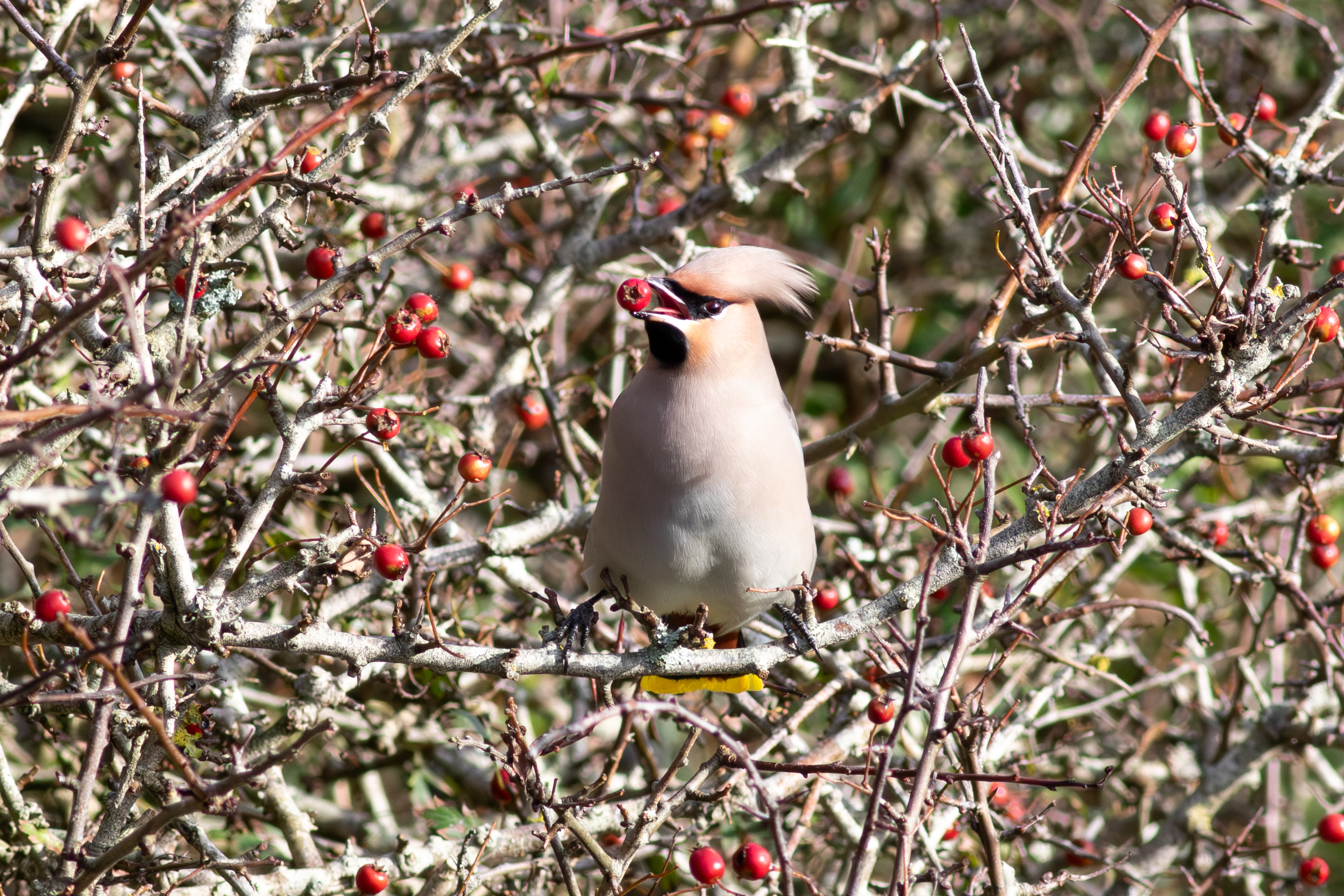 Waxwing among the limited selection of berries currently on offer in Millcombe © Joe Parker
 Waxwing in Sycamores above the Battlements © Angus Croudace
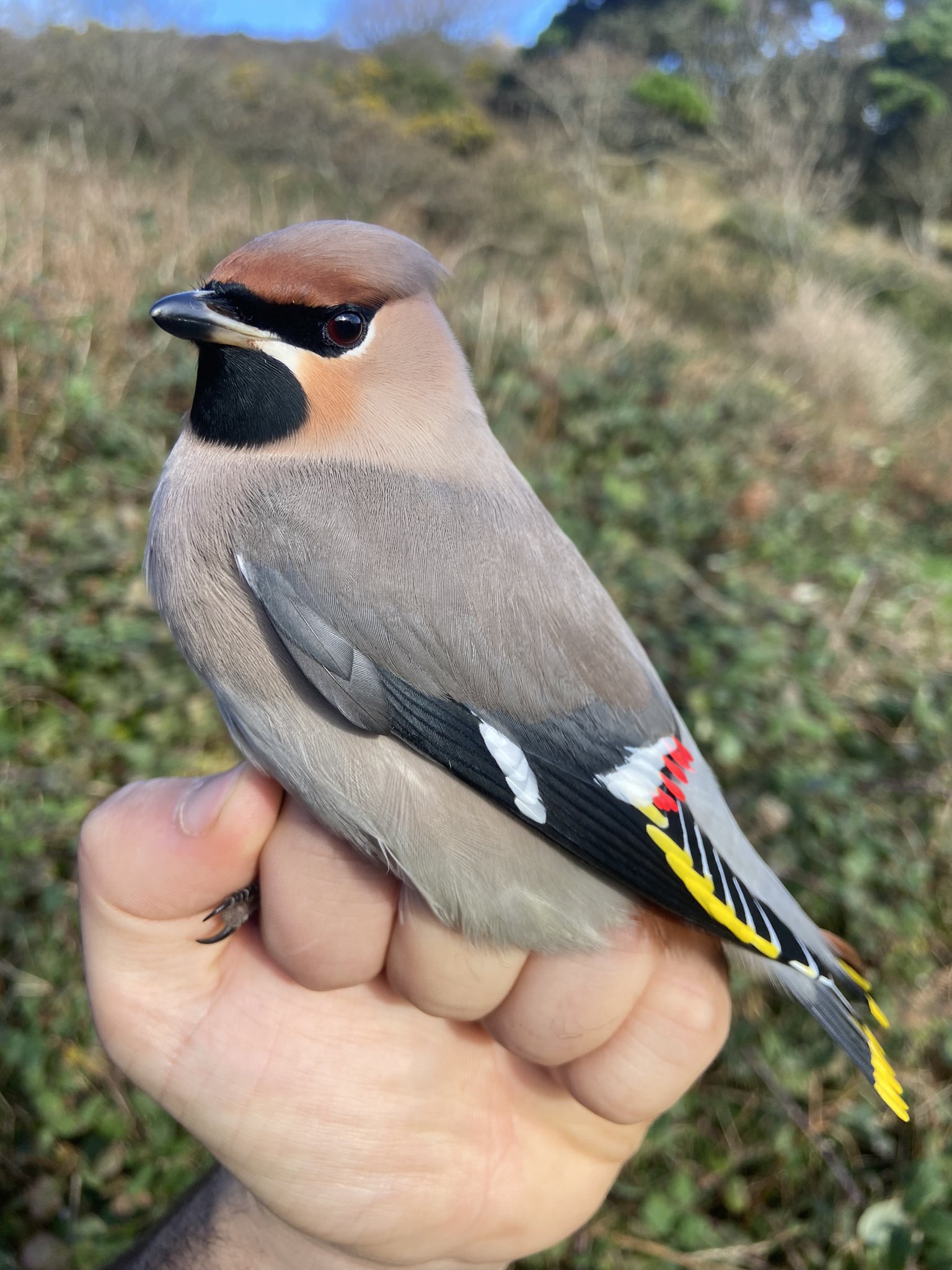 Waxwing in the hand © Luke Marriner
A couple of late Swallow were followed by six 31st, some of which roosted overnight, with three picked up again on 1st. A single bird was recorded struggling in gale force winds over the Airfield on 2nd – we were pleased to see that it had survived through to the 3rd, flying around the Village. The biggest movement of Skylark was a flock of nine on 30th, otherwise just a couple of singles – a big contrast to Skokholm a bit further north which reported several hundred moving through on 31st! A Woodlark was found sheltering from the 60mph gusts in the heather around Rocket Pole during the morning of 2nd.
Stonechat numbers have been notably low this week, often in low single figures. A late Northern Wheatear was in Brick Field on 30th. Three days in this period have seen no wagtails of any species, otherwise just a few single alba/Pied Wagtails recorded, with one Grey Wagtail on 27th.
Chaffinch numbers have been around 225 throughout 27th-31st except for 401 on 29th. This was also likely an undercount as birds were moving through in modest numbers, but we lacked the coverage to monitor the full extent. Nearby, at Bull Point on the N Devon coast, in excess of 5,000 were recorded on the same morning, although we suspect that some showers out to sea to the north of Lundy meant that the birds moved up the Bristol Channel before making the crossing, hence lower numbers over us despite favourable winds. Passage had stopped by 1st, with just a score or so found feeding on the tracks or in Millcombe. Just four records of Brambling this week, including a female ringed in Millcombe. We noted about 80 Siskin daily until Storm Ciarán, after which just single figures were to be found. A small flock of 8 Linnet has been feeding in St John's Valley this week, with a couple of singles picked up elsewhere. Two Lesser Redpoll on 27th are currently the last record in the logbook, and on the same day three Snow Bunting were seen on the wall around Tibbetts, although sadly not resighted since.
 Male Brambling in Sycamores above Millcombe pines © Angus Croudace
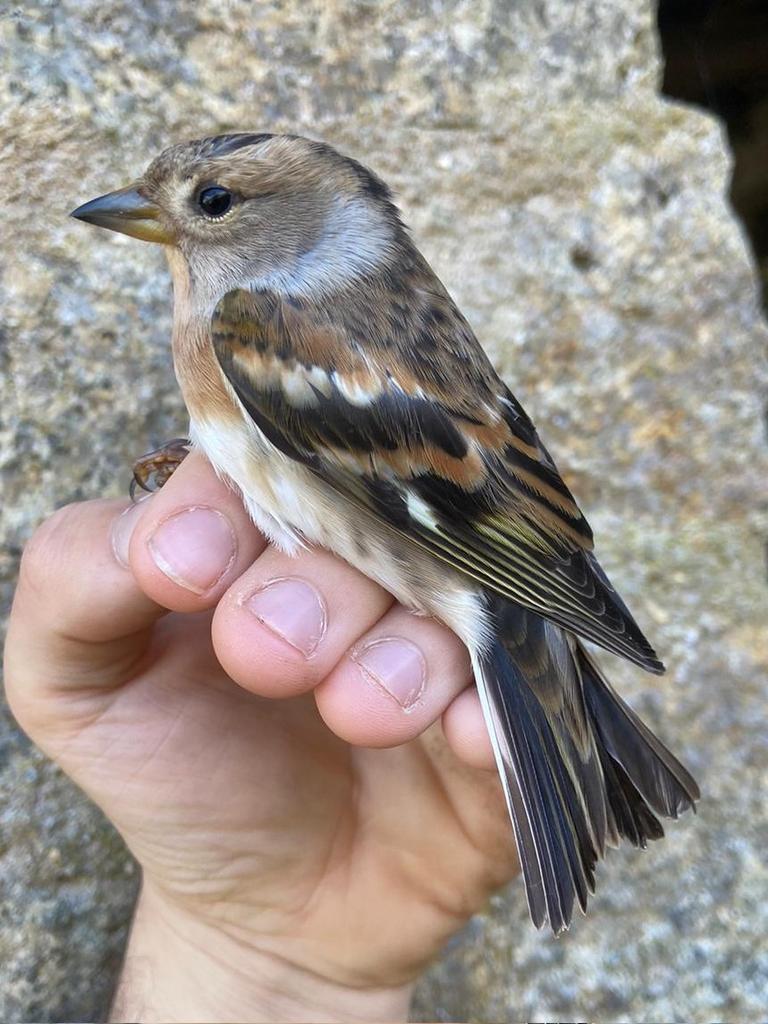 Female Brambling ringed in Millcombe © Luke Marriner
17th to 26th October 2023
The most notable weather patterns this week were some strong easterlies 17th-19th and another period of lighter south-easterlies 22-23rd. The 25th brought light north-easterly winds before they dropped to nothing for the afternoon. More typical autumnal sunshine and showers from south westerlies returned on the 26th.
 Juvenile Pallid Harrier © Eden Davies
 Initial Views of juvenile Pallid Harrier over Quarries © Tim Jones
 Juvenile Pallid Harrier © Eden Davies
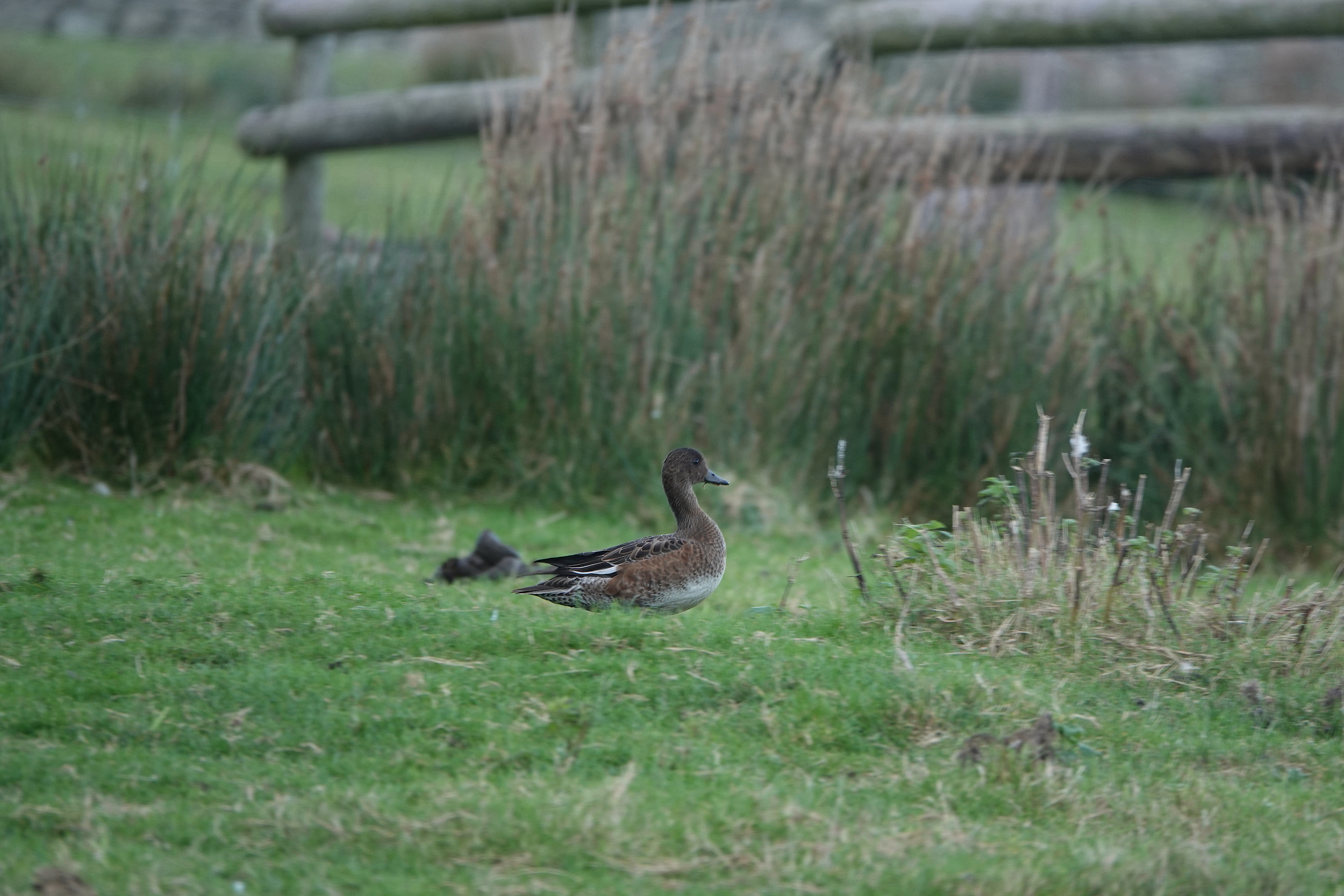 First-winter male Wigeon at Barton Field © Tim Jones
 Common Scoter off of North Light on the 19th © Tim Jones
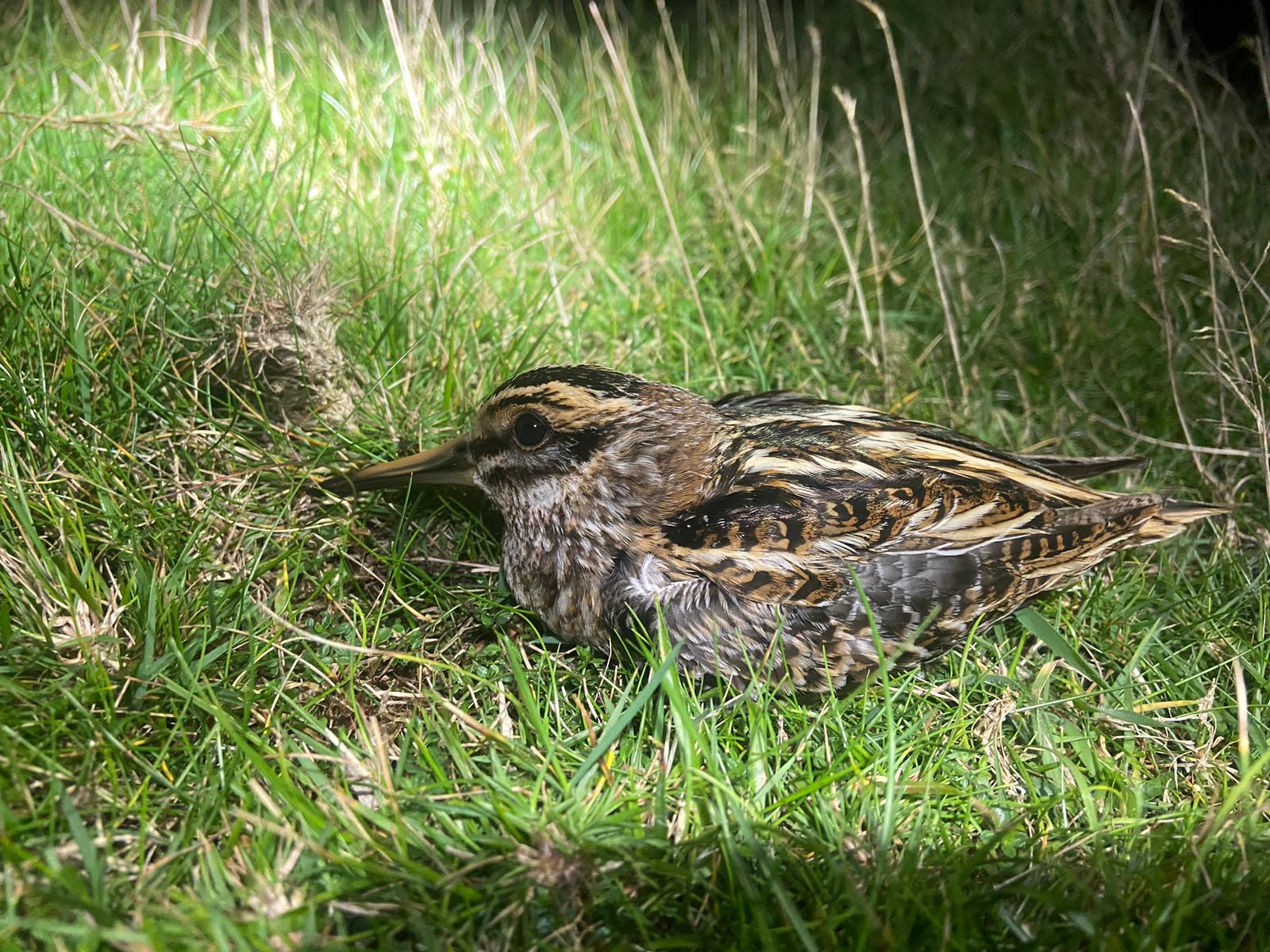 Jack Snipe Barton Field © Luke Marriner
 Yellow-Browed Warbler Quarter Wall Copse © Angus Croudace
 A stunning male Common Redstart at Stoneycroft © Angus Croudace
 Firecrest ringed in Millcombe © Luke Marriner
 Female type Black Redstart by Lambing Shed/Lodge © Angus Croudace
 Fieldfare Millcombe © Tim Jones
 Ringing station in Millcombe with (L-R) Luke Marriner, Joe Parker and Paul Morton © Tim Jones
11th to 16th October 2023
Prevailing south-westerlies carrying heavy rainfall overnight start this period. A bright, still and warm day on the 12th played host to our first large thrush passage. The winds subsequently swung north-west causing the temperature to drop on Saturday 14th before then becoming moderate easterlies on 15th-16th.
 Redshank Barton Field © Richard Campey
 Common Snipe flock over Airfield © Angus Croudace
 Common Snipe, Millcombe Drive © Angus Croudace
 Great Northern Diver Landing Bay © Angus Croudace
 Merlin Quarter Wall © Richard Campey
 Short-eared Owl Lighthouse Field © Tim Jones
 Merlin double act at the North End © Angus Croudace
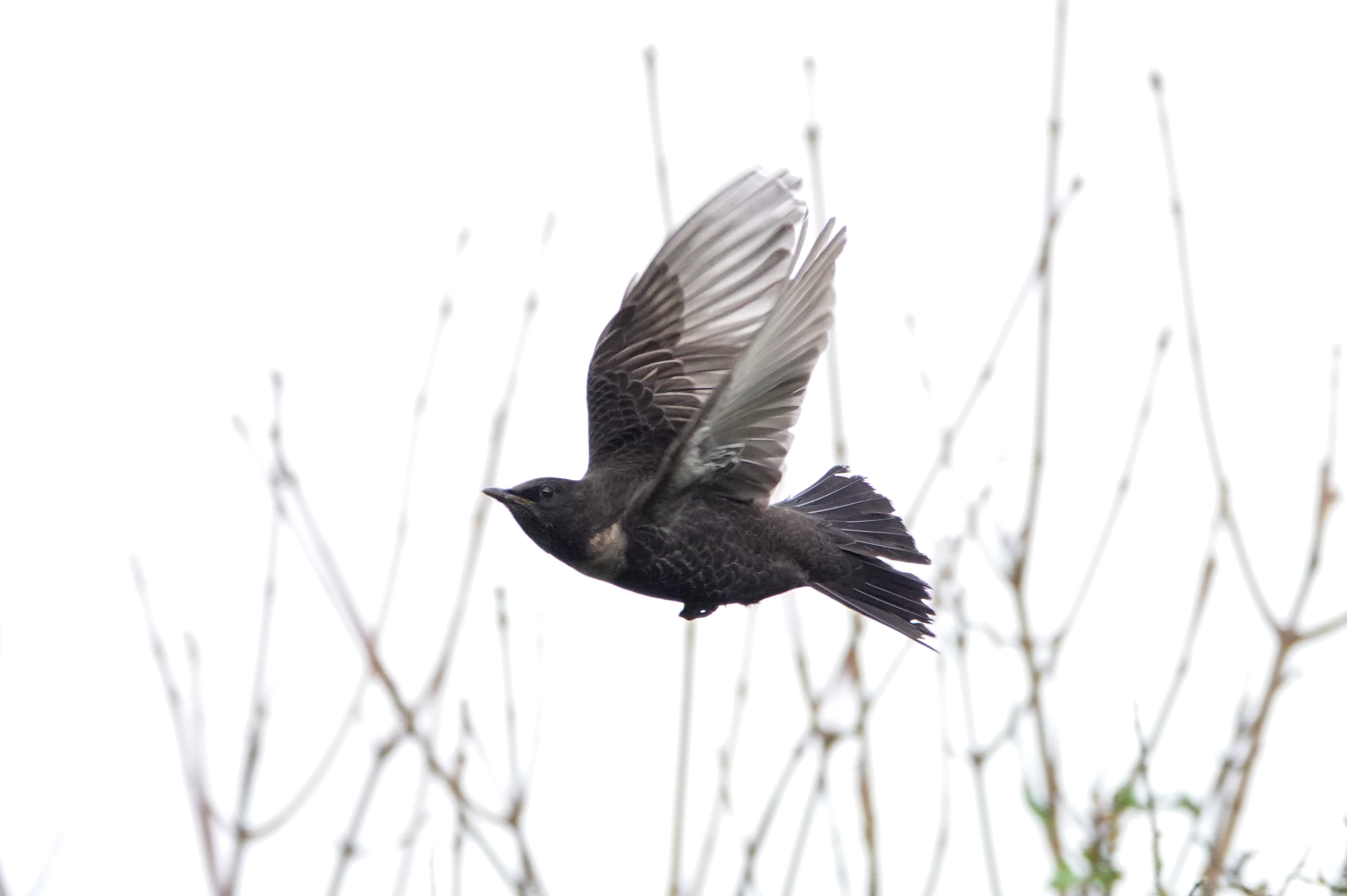 First-year Male Ring Ouzel in Millcombe (note the worn tail feathers) © Angus Croudace
 Ring Ouzel Jenny's Cove © Tim Jones
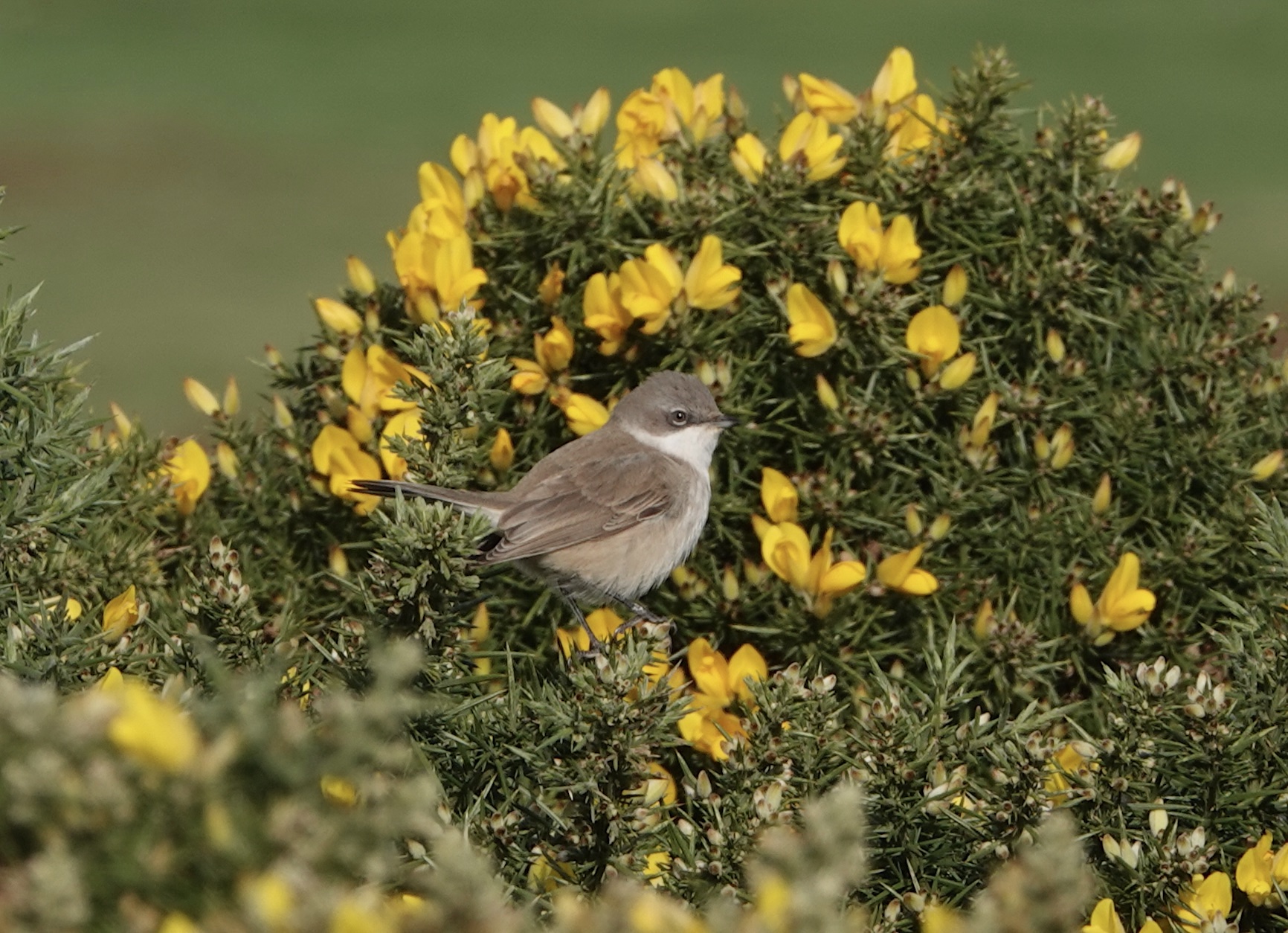 Lesser Whitethroat Rocket Pole © Tim Jones
 White Wagtail Barton Field © Tim Jones
 Lesser Redpoll Lower Garden, Millcombe © Angus Croudace
 Reed Bunting Pondsbury © Richard Campey
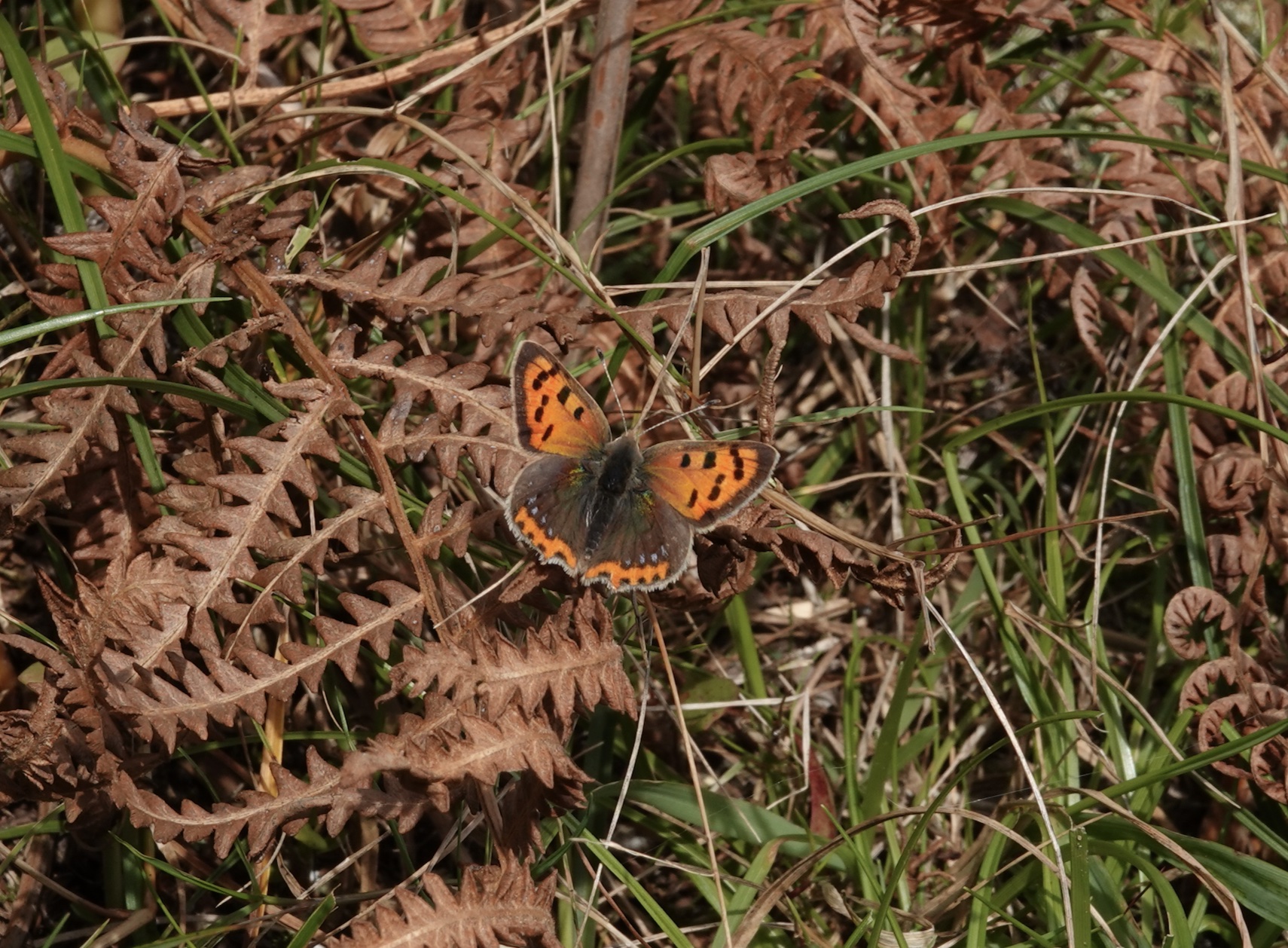 Small Copper butterfly at North Quarry © Tim Jones
 Pale Tussock Moth caterpillar meets a migrant Blackbird © Angus Croudace
 The race is on, Merlin vs Sika Doe Pondsbury © Angus Croudace
3rd to 10th October 2023
The weather has been fairly consistent for 3-6th October, with moderate winds from the south-west limiting any passage on a large scale over Lundy. The tail end of this week featured much lighter winds and glorious sun on the 8th, with some extended periods of heavy fog on the 9th-10th.
Golden Plover records have been almost daily in this period, with an autumn high count thus far of nine over Millcombe on the 9th, with the flock interestingly led by a single Bar-tailed Godwit, and tailed by a single Snipe! A flock of 24 Oystercatchers was seen at Quarry Beach on the 4th.
A single Great Northern Diver was in the Landing Bay on the morning of the 7th. On an island-wide seal survey on the 4th two Arctic Skuas were picked up, a pale morph from North Light and a dark morph causing havoc in a Gannet feeding flock east of the Landing Bay. A Mediterranean Gull was picked up in the Landing Bay on the 5th and another off of the east with 115 Kittiwake on the 7th. A first-winter Yellow-Legged Gull was present in the Landing Bay on the 10th. After the fog cleared on the 9th and 10th the seabirds started feeding in earnest, with a lot of Gannet activity - 120 recorded off of the east feeding on the 9th. Our second autumn flock of presumably dispersed, roving Grey Heron was picked up on the 10th, with 17 east of the Landing Bay shortly after dawn making quite the spectacle, albeit at a distance!
 Golden Plover, Airfield © Angus Croudace