


Bird Sightings
23/07/24 – Roy Dennis visits Lundy!
By Tara McEvoy-Wilding
Thursday was yet another sunny day on Lundy. Whilst I did some office work, Thomas did census where he sighted a Ringed Plover at Benjamins Chair and and the pair of Channel Wagtails at Quarter Wall Pond. Before long it was time to head down to the boat. Sadly in the Landing Bay the first seal pup of the year was spotted floating dead near Christies Quay. We don't know what caused it's death but it was only ~3 days old.
Me and Thomas met Roy Dennis and his partner Moira off of the Oldenburg. Roy Dennis was the Assistant Warden on Lundy in 1958 and hadn't returned since so it was an exciting day. After leaving Lundy, he moved to Fair Isle and has played a key part in restoring populations of White-tailed Eagle, Osprey, Red Kite and Goldeneye amongst other species in the UK over the last 60 years! He is currently in the area as he is helping with the reintroduction of White-tailed Eagles to Exmoor!
After doing the landrover lifts up the hill and a quick pasty we set off for Old Light, where Roy and the Warden used to live and we climbed the steps to the top to enjoy the view. Roy pointed out where Heligoland Traps used to be located, as these were the main locations for ringing on the island. As well as the Terrace trap which is still in place today, there were traps at Quarter Wall and in Stoneycroft Paddock. Millcombe was generally out of bounds for birding as it was the Harman family's private area of the island.

We then wandered up the west coast to the site of the Manx Shearwater artifcial nest boxes where we checked on a couple of chicks and told Roy about the project and the success Manx Shearwaters have had on Lundy since the rats were eradicated 20 years ago.

We hopped back in the Landrover and drove up the island towards Tibbetts, stopping along the way. We learnt that Pondsbury used to be smaller and without an island as there wasn't a dam on the westside to hold the water in and Roy told us about going to visit Mr Tibbett when he was assistant warden. By this point we were running out of time so we headed back to the village and Thomas, Roy and Moira walked down through Millcombe while I did the lifts down.
It was great to have Roy visit the island and learn about what life was like on Lundy when he was doing my job! Hopefully we will be seeing White-tailed Eagles visiting Lundy from Exmoor soon!
22/07/2026 – A Clear Out of Migrants?
By Thomas Weston
The day started with me getting ready for census. A thick band of nice cloud and a cold NE wind braced the island which was refreshing to say the least. Pairs of Swallows flew overhead with up to 10 seen in total. Walking towards Millcombe there were a lot of calls and activity amongst the bushes. A pair of Woodpigeons were in the trees, and a mix of warblers were seen with 7 Willows, 1 Chiffchaff, and a Blackcap noted. I saw our breeding pair of Spotted Flycatchers with their juvenile, and throughout the Valley, 2 Chaffinches, 3 Blackbirds, a Dunnock, and Wrens were noted. A couple of Oystercatchers, 4 Shags, and a flyby Common Sandpiper were in the Landing Bay and on the way out of St John's Valley, 3 Mallards were seen distantly in Barton Field. Off Benjamin’s Chair, 4 Kittiwakes and 7 Gannets were seen in a feeding frenzy. Gulls were in mixed flocks but consisted of 4 Great Black-backed Gulls, 11 Herring Gulls, and a Lesser Black-backed Gull was spotted. Across the plateau, 5 Stonechats, 4 Wheatears, 3 Pied Wagtails, 44 Meadow Pipits, 78 Linnets, and 29 Goldfinches were noted.
I was then joined by Lucile and we tried to catch House Sparrows and Starlings with mixed success resulting in a lot of great Starling data. After completing some admin in between trap checks, we later checked the Channel Wagtail pair’s second brood nest and found both chicks unfortunately dead in the nest. It would be highly likely the chicks were never going to make it due to genetics and the fact that the adults had invested so much in their first brood. There is always next year!
The afternoon involved more ringing-related admin, helping set a net near the Chicken Coop and heading out in the night to catch Wheatears before heading to the slopes to catch Manx Shearwaters. Both species are high quality ringing on the island, the former helping towards the Wheatear colour-ringing RAS and the latter helping towards our 50 years of understanding the colony on the west coast. Fun, fun, fun! Some brief dull aurora, the Milky Way and a few meteorites seen too.
21/07/26 – Warblers and Butterflies
By Chloë Langmead
Today started with a butterfly transect along the lower east path. The hot, sunny weather has brought the butterflies out in full force! There were Large Whites, Small Whites and Peacocks flitting around Millcombe, Red Admirals and Painted Ladies throughout the walk in healthy numbers. I counted 8 Ringlets and of course there were 90 Meadow Browns! Additionally, there were a few Hummingbird Hawk-moths and several Silver Ys.
Meanwhile, Greg was out on census with the highlights being 29 Willow Warblers, 6 Sedge Warblers and 2 Grasshopper Warblers. Additionally, he also saw a migrant Hawker Dragonfly near Millcombe Pines.

Next on the agenda for me was Seabird Station at Jenny's Cove. The sun was shining bright, and Jenny’s looked beautiful as always, with the ocean looking particularly inviting in this hot weather. Thankfully there was a gentle, cool breeze to keep me from baking too much! Despite most of the auks having left, with the Guillemot cliffs looking stark, there were still just enough Puffins out rafting on the water to show the day trippers, all of whom were pleasantly surprised and happy.

20/07/2026 – A night walk and a day walk with birds and butterflies.
By Lucile Doyen
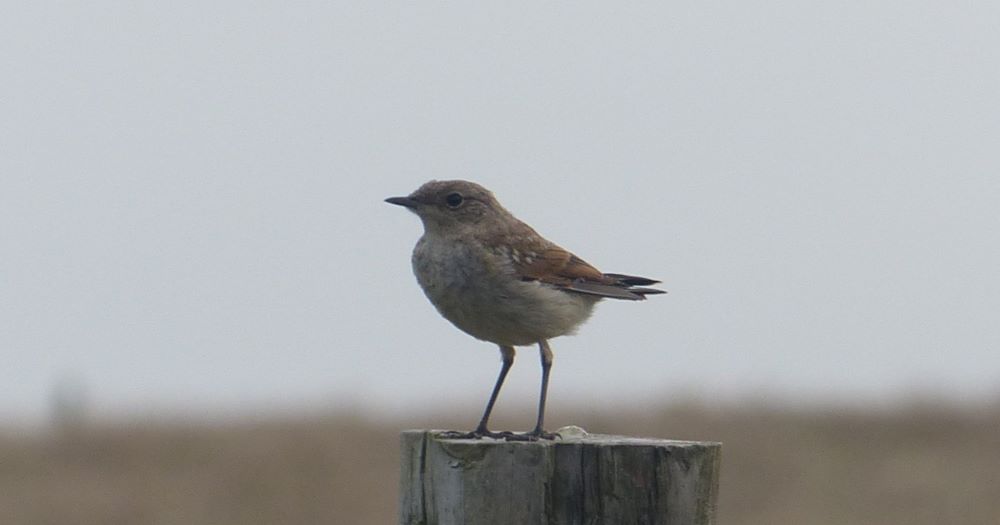 A Wheatear juvenile by Lucile
For Emma, Jessie, Thomas and I, this week started with a nice little tour on a designated path, which would hopefully allow us to meet some young Wheatears (Oenanthe oenanthe). The little expedition took place at dusk and would end early on Monday, just after midnight. Thomas was leading with a thermal camera, through which he detected the birds sleeping on the path before catching them with a net. Out of 14 birds seen, 9 were successfully trapped and ringed! We first measured the tarsus width of each individual to confirm the subspecies and ensure fitting the correct ring size : the british subspecies would take a smaller (A) ring than the greenland one (B sized ring). Wheaters are a very interesting species : they have a complete ossification of the skull in only two months, which usually take around six months in juvenile passerines (Svensson, L., 1992)1.
1Identification Guide to European Passerines. Lars Svensson. British Trust for Ornithology.
Later in the morning, I monitored the last active brood of our House Sparrows (Passer domesticus). This is the second brood of a couple of one year old sparrows, which re-used the outstanding nest they made for their first brood. This may have allowed them to save some time, and the time interval between their two broods was 7 days (with a mean of 12.75 days for our population, s.d. = 4.34). This was a rather little brood of just two chicks, one of them being unfortunately half the weight of the other when weighed at 5 days old. At ten days old, the imbalance in food intake between the two siblings got the better of this little chick. Life can be rough, but it is also beautiful. All nestlings from first broods made it, and we got a good survival of 72.7% in our second broods, with a population now estimated to 73 House Sparrows! It is a real pleasure to see them around, way more numerous than at the beginning of the breeding season.
 Painted Lady by Lucile
In the afternoon, I walked along the east coast. I started the promenade by following butterflies: mostly Red Admirals (Vanessa atalanta), Painted Ladies (Vanessa cardui) and Meadow Browns (Maniola jurtina).
 Pied Wagtail by Lucile
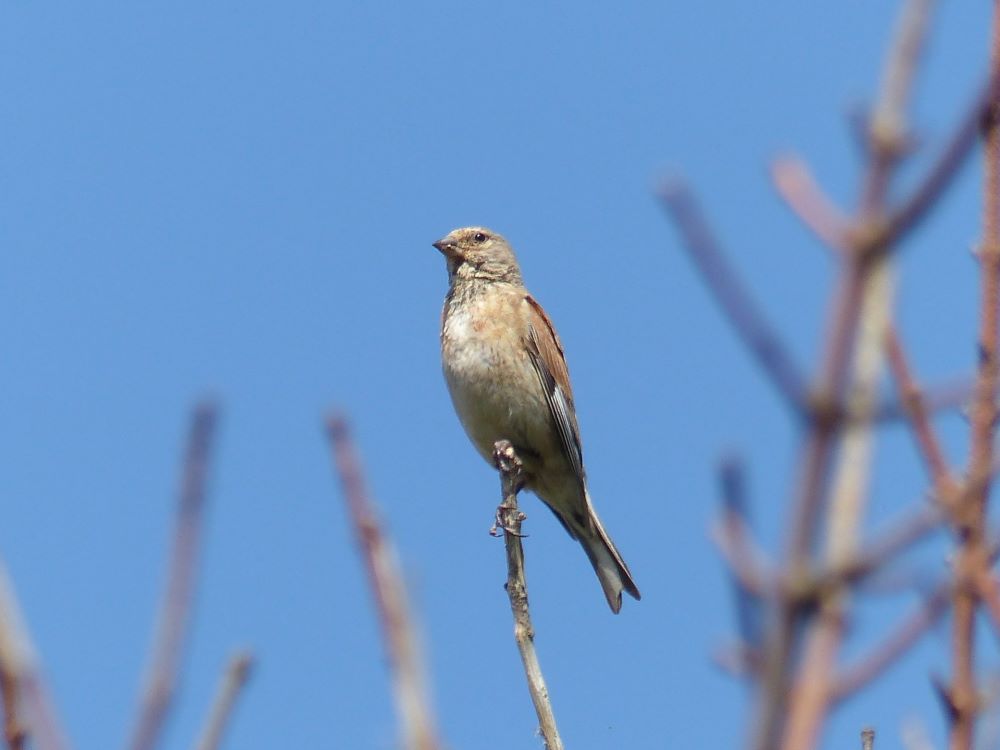 Linnet by Lucile
On the first tree, 3 Pied Wagtails (Motacilla alba) and a Linnet (Linaria cannabina) have found shelter on the trees. Adult and juvenile Stonechats were flying around, landing on fences and bracken. A lot of migrant Willow Warblers halted on the island, and I could see ten of them hiding on the vegetation just around the goldfish pond.
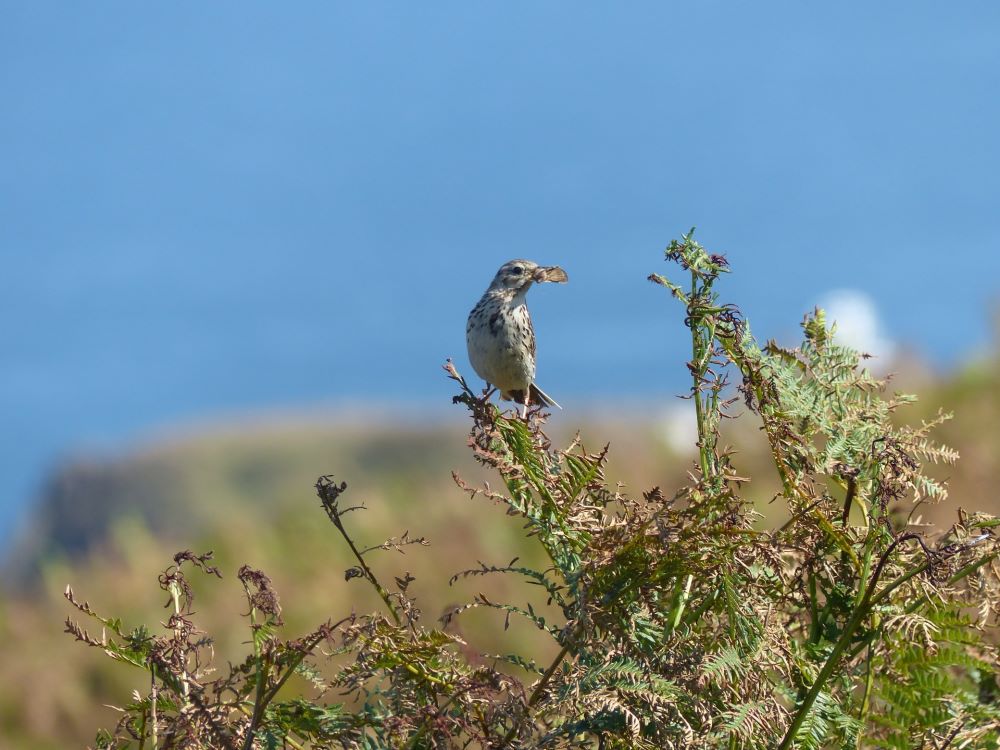 Meadow Pipit by Lucile
The promenade led by butterflies ended with one of them being caught by a Meadow pipit for the goûter.
The day ended up with a Wingspan game, a board game where players collect bird cards, eggs, resources, and try to get the best score out of this. I teamed with Chloë, and playing a Ring-billed Gull and a Bald Eagle led us to victory! We hope the former arrives on the island this autumn.